What is Sovereign AI?
Sovereign AI is the deployment, operation, and refinement of AI entirely within an enterprise-controlled environment. Every part of the runtime, including prompts, vectors, tokens, model execution, retrieval, tool calls, logs, and intermediate processing, must remain inside that sovereign envelope. If any part of the AI runtime crosses outside the enterprise's control framework, sovereignty is broken.
In plain English: Every part of the AI run is inside corporate control. Every part.
Like many other things, the Sovereign AI ideal collides with the boots-on-the-ground reality of running an effective IT department. As Mike Tyson famously said, "Everyone has a plan until they get punched in the face." For Sovereign AI, the punch in the face is the daily push of IT teams working diligently to get things done within real timeframes, team demands, operating constraints, and budgets. In other words, Sovereign AI is nice...but we are running a business here.
That punch draws out something very important: deviations may be inevitable. But they should never be accidental. Where they happen, they should happen deliberately, with a clear understanding of the risk surface.
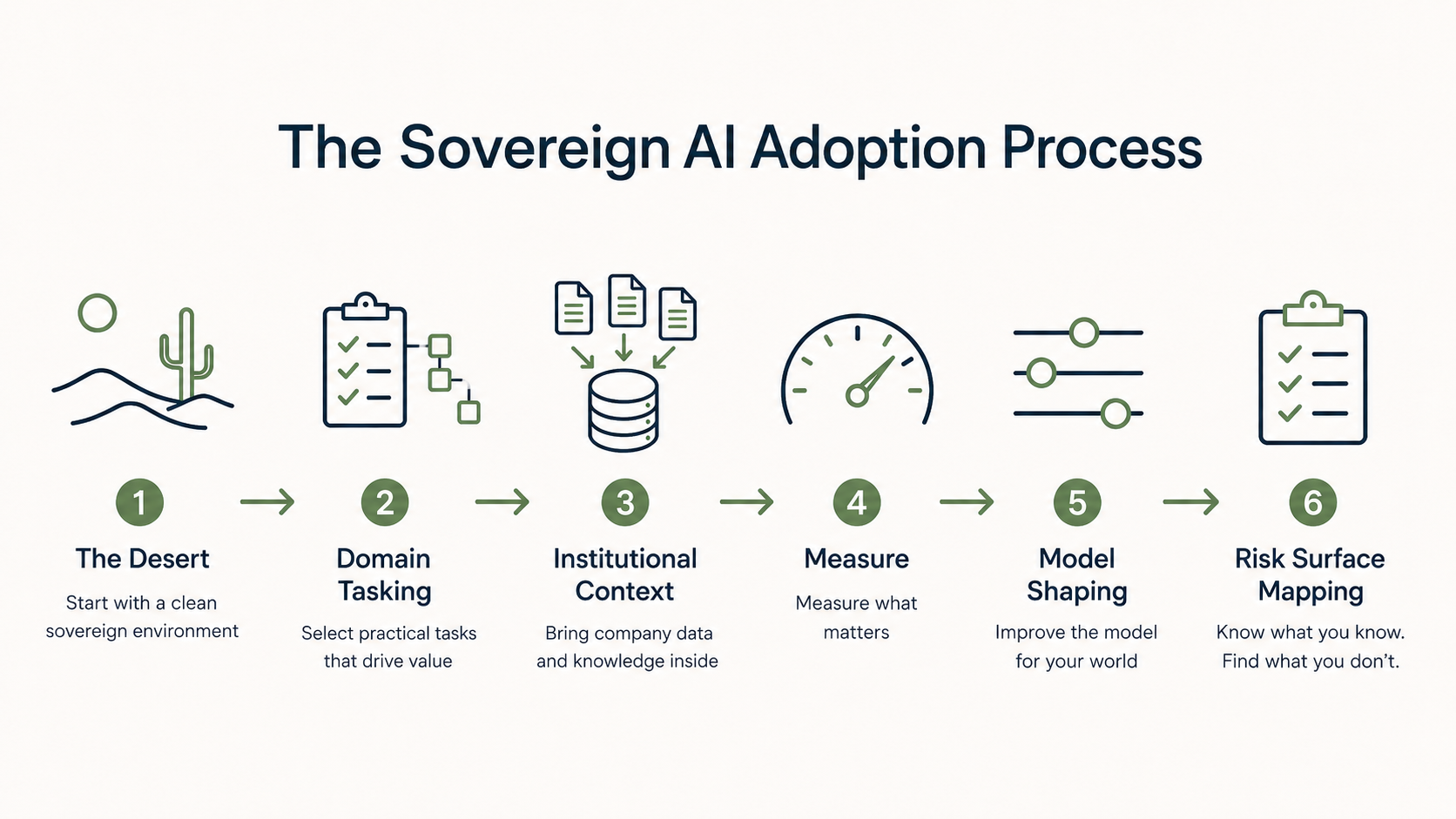
The Practical Way to Get Started
We proceed from a simple idea. Every IT team needs to know how to run its own AI. It is quickly becoming one of those things every team needs to have as internal company knowledge.
There is an entire book to be written about why. But in a nutshell, the promise of AI is not all about ChatGPT and Claude. It is also about small, domain-focused models doing important work that may never need to see the Internet.
Start in Complete Isolation. (aka The Desert)
We call the first stage The Desert. The idea harkens back to the Jet Propulsion Laboratory. In short, Caltech loved what the suicide squad was doing with rockets, but they loved it more when they were doing it out in the desert. Small team. Smart people. Defined blast radius.
Don't build the company AI strategy. Don't roll out AI to 5,000 employees. Don't build a steering committee. The objective is much more basic: build a small group of people inside the company who actually know how to run AI.
That means standing up models, understanding runtimes, dealing with GPUs, figuring out inference engines, securing the environment, breaking things, fixing things, and learning what actually matters when the model is no longer somebody else's API call.
One of the biggest skill sets is containment. How do you screen it? How do you sandbox it? How do you air-gap it? A shameless plug: this is exactly the kind of problem nFOX is built to solve.
There is an important reason to start this way. Sovereign AI is not a product you buy and install. It is a capability you build. The company needs people who understand the machinery before it can make intelligent decisions about where that machinery belongs.
Keep the team small. Keep the mandate broad. Give them enough room to experiment. The point of The Desert is not production. The point is competence.
Domain Tasking (aka Pick a Real Goal)
Now give the team something real to do. Not "explore AI." Not "find use cases." Give them an actual business problem with a real user, a real workflow, and some way to tell if the thing works.
This matters because the learning curve is twofold. The team is learning how to run and tune the AI. But it also faces the reality of ugly data, incomplete instructions, edge cases, bad inputs, latency, users who do unexpected things, and a business process that probably makes less sense than anyone wants to admit.
That is the point.
The first task does not need to be glamorous. In fact, it probably should not be. Pick something bounded, useful, measurable, and close enough to the business that someone will care whether it succeeds.
Institutional Context (aka Start Adding Data)
Once the team has gotten its base plan together, they are going to ask for something important: data. Real data. Company data.
There are two rules here. The first is simple: data can come into the desert, but it does not come back out. That is the whole point of the desert. It has a very defined blast radius. The second is: don't put data into the desert that is too sensitive. Maybe use historical data. Maybe use obfuscated data.
Overcautious? Maybe. Just remember what we are doing here: developing institutional knowledge. Don't do anything unless you understand the risk surface.
The real value is the combination of the model and the company's accumulated knowledge. This is where things really start to happen. Team members start to see the whole solution set. It is not just the AI model. Oftentimes it is a data pipeline, refinement, presenting a choice to the AI, and creating a coherent output.
Measure (aka Manage)
The age-old truth: what gets measured gets managed. Build tests. Establish baselines. Track misses. Track hallucinations. Track latency. Track cost. Track whether the model is doing the job better, faster, or more consistently than whatever came before it. If the task is important enough to give to AI, it is important enough to measure.
This is also where the team starts building something extremely valuable: its own evaluation corpus. Real prompts. Real failures. Real edge cases. Real examples of what good looks like. That becomes the scoreboard for every model, every tuning decision, and every future change.
Model Shaping (aka AI Engineering)
Not until the team is ready.
If this project has a punch in the face, this is the spot where it is going to land forcefully. I can't stress this enough. Even in these early days of AI, too many projects have rushed into model training. The results have often been disastrous.
Knowing what belongs in storage versus what actually belongs in training is critically important.
Quick takeaway: LLMs are statistical relevance engines. If you "train" on something like a phone book, you are asking a statistical relevance system to recover deterministic values. Results may vary.
This is where the team starts moving from operating AI to actually engineering it: tuning, fine-tuning, quantization, pruning, routing, ablation, and more advanced model adaptation. But by this point, those decisions are being made against a real task, real company data, and a real measurement framework.
Risk Surface Mapping (aka Know What You Know)
By this point the team has learned a lot. Some of it is obvious. Some of it came from breaking things: challenging the sandbox and containment, struggling with data, stress testing the model, and finding out where assumptions did not hold.
The process is capturing the known knowns and the known unknowns. "With this model we tried a token escape. This is what happened." "With this model we challenged the sandbox. This is what happened." "We gave it this kind of data. This is where it struggled." That is institutional knowledge at work.
Now let's say an important existing vendor comes to you and says, "We have an AI that could be transformative for your business." The company is no longer operating on blind trust. The team can evaluate that model against a defined risk surface because it has already learned what to test, what to challenge, what to measure, and where things tend to break.
Even a small Sovereign AI project gives the team a valuable "been there, done that, got the commemorative mug" background. That experience changes the conversation. The company is no longer asking whether the AI sounds impressive. It is asking the much better question: what do we actually know about the risks?
Where nFOX Helps
nFOX helps create the controlled environment around the work. It gives teams a way to scan models before they run them, contain them at the kernel level, stress test behavior, monitor what happens at runtime, and preserve evidence of what the model actually did. In other words, it helps define and enforce the sovereign envelope while the team is still learning.
But the bigger role is helping the team learn. nFOX gives the team a framework for asking better questions: What is this model doing? What can it access? What happens when we push it? Where does containment hold? Where does the risk surface change? What did we learn this time that we should carry into the next project?
That is the connective tissue across the entire Sovereign AI adoption process.
The Desert gives the team room to learn. Domain Tasking gives it something real to solve. Institutional Context gives the model something valuable to work with. Measurement tells the team whether it is working. Model Shaping makes the system better. Risk Surface Mapping turns the experience into institutional knowledge.
nFOX helps make that progression safer, more observable, and more repeatable.
The goal is not just to run private AI. The goal is to know your AI.